YOU ARE HERE Pest Watch > Whitefly control
Pest Watch
Whitefly control
Whitefly are a difficult plant pest that can be a problem to control.
The flies can be found on the leaves of plants - both on the upper and lower surfaces, but mainly on the latter.
These are the adults, which feed on growing foliage and lay eggs that hatch into tiny white scales that remain attached to the underside of leaves. Like aphids (greenfly, blackfly), whitefly are sap-sucking insect pests. This sap sucking weakens the plant and may introduce plant viruses that further weaken the plant, and may even kill it.
|
Whitefly scales (larvae) on the back of a leaf |

|
Whitefly adults |
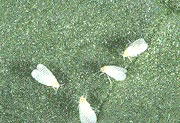
Unfortunately, whitefly don't go round in ones or two - they go round in hordes of hundreds and a severe attack can severely weaken a plant. You will often see a 'cloud' of whitefly flying away from a plant whose leaves have been disturbed.
But this has another drawback, too. The large amounts of sugar-rich exudate they excrete plays host to a fungus called sooty mould. When the exudate lands on leaves below where the whitefly are feeding, these leaves then become covered in the black, sooty mould. Although this does no direct damage, it does stop the leaves from receiving sunlight, so they are unable to manufacture food for the plant (via photosynthesis). Some gardeners believe they have a disease problem when, in fact, they have a pest problem!
Whitefly tend to be more of a problem in greenhouses and indoors, but one species is very troublesome on brassicas, and another on tomatoes and related crops.
Control
Sadly, whitefly can be difficult to control - some people say impossible - because they have a very fast lifecycle; they can develop from egg to adult in as little as three weeks in the summer. This means that if you are using contact or organic chemical pesticides to kill them, you have to spray very regularly to control a severe outbreak; in the height of a hot summer this could be every two or three days. And then you have to be very vigilant to catch other outbreaks early. If you've only a few plants it is simpler to check over them regularly and squash adults and scales (you can just about see them) as soon as they appear.
Prevention is better than cure and covering plants with a layer of horticultural fleece will stop the pest getting at them - although it might not look very pretty in the ornamental garden! But brassicas and other vegetables can easily be protected as long as uninfected plants only are covered, the edges are buried in the ground, and the fleece is kept on until harvest.
Covering greenhouse vents with fleece and making a door screen from the same material will help reduce attacks under cover.
'Organic' or 'natural' insecticides are contact insecticides - they only kill the whitefly they come into contact with - which means you have to use them very regularly, often every other day in summer to give good control.
You'll get much better results using Provanto Smart Bug Killer, Provanto Ultimate Bug Killer, Provanto Ultimate Fruit & Vegetable Bug Killer, Resolva Bug Killer or BugClear Ultra. There are only certain edible crops that these insecticides can be used on; check the label before using.
I've also tried Plant Invigorator SB with good results. This is not a pesticide per se, but a plant growth stimulant that also controls pests by physical methods.
In the greenhouse you can catch them by hanging yellow sticky traps just above the leaves of plants - they are attracted to the colour yellow, which is why I've never been able to work out why growing-bags are that colour! Some people even vacuum their plants regularly to remove the little flying pests!
Use plant protection products safely. Always read the label and product information before use.
Biological control
Whitefly are best controlled in the greenhouse by biological control - using another insect that kills them and so do the work for you.
Encarsia is a small parasitic wasp that lays its eggs in the scales where the larvae develop and so kill the scale. The Encarsia larvae hatch into adults, which find more scales to parasitise. However, once it has done its job, there is no food source for the larvae and so the lifecycle stops. If a further outbreak occurs then you have to re-introduce the Encarsia. Luckily, Encarsia rarely kills all its hosts, so there are usually some to carry on the lifecycle.
Encarsia is available from various mail order suppliers.
In order to keep your whitefly killers safely within the greenhouse where they will sort out your whitefly problem, it's a good idea to again use fleece over the vents and doors. And, you can't use insecticides (although soft soap can be used before the controls are introduced) while the controls are busy at work - so you'll have to trust them.
If you want to know more, or if you've got a gardening problem you need help with, then send an e-mail to: info@gardenforumhorticulture.co.uk
Problems with slugs & snails, aphids, scale insect, vine weevil or lily beetle?