YOU ARE HERE Pest Watch > Slug & snail control
Pest Watch
Slug & snail control
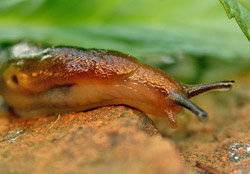 Slugs and snails are the number one garden plant pest problem. They attack a wide range of young and tender garden plants, especially annuals, perennials - particularly hostas - and vegetables. Gardeners with slug or snail problems should take steps to control them.
Slugs and snails eat irregularly shaped holes in leaves, stems, buds and flowers, as well as bulbs, corms and tubers. Some slugs, especially keel slugs, spend most or all their life underground and are a real problem on potatoes and other underground storage organs.
Most slugs feed at night, although not exclusively, and tell-tale slime trails are often present – but not always. Slug and snail damage is most severe during warm humid periods, especially in spring and autumn.
Slug & snail control
Keep a close eye on plants once you notice slug or snail attacks and deal with any further outbreaks you see. Go out with a torch during the evening and pick them off by hand and place in a container. Kill them in hot water or a strong salt solution. Don't throw them over the fence; believe it or not, they have a strong homing instinct and will soon come back.
Some birds as well as frogs, toads, hedgehogs, slow-worms and ground beetles eat slugs and these should be encouraged into your garden.
Always remove debris and fallen leaves, as these make excellent hiding places and breeding grounds for slugs and snails.
A biological control (Nemaslug) based on microscopic nematodes is available from a number of biological control mail order suppliers.
Numerous other non-chemical, physical control methods are available, but I'm not totally convinced about their efficacy. Many barrier types, for example, won't stop those slugs that live in the soil! However, some people swear by them.
Place traps, such as scooped-out half oranges, grapefruits or melons skins, laid cut side down, or jam jars part-filled with beer sunk into the soil near vulnerable plants. Check and empty regularly. Proprietary traps are available from numerous suppliers. I don't like beer traps (it's a waste of good beer!) as they also trap gardening friends, such as ground beetles.
Physical barriers
Place barriers around susceptible plants.
These include anything sharp and gritty, including sharp sand, egg shells and cinders. Moisture-absorbent minerals are available to place around plants to create barriers, including Growing Success Slug Stop and Vitax Slug Off. Similarly, gel repellents are available - Doff Slug Defence Gel.
However, recent research by the RHS agrees with me and shows that the barrier method isn't very successful
Around pots or raised beds you can use copper tape (Agralan Copper Slug Tape, Growing Success Slug Barrier Tape, Vitax Copper Slug Tape) or stand containers on copper-impregnated matting (Agralan Slug and Weed Mat, Slug and Snail Shocka). This matting can also be cut into collars to place around the stems of susceptible plants. These create a mild electric shock for the slug, which deters them!
Chemical control
To my mind, the most successful way of preventing slugs and snails getting at prize plants is to use slug pellets – and to use them correctly, as directed on the container.
Slug pellets based on the active ingredient ferric phosphate – a naturally occurring mineral – are very effective. There are several brands including Doff Super Slug Killer, Growing Success Advanced Slug Killer, Neudorff Sluggo Slug & Snail Killer, Richard Jackson Garden Slug & Snail Control, SlugClear Ultra 3 and Vitax Slug Rid. These are approved for organic gardening.
Use plant protection products safely. Always read the label and product information before use.
If you want to know more, or if you've got a gardening problem you need help with, then send an e-mail to: info@gardenforumhorticulture.co.uk
Problems with aphids, scale insect, vine weevil, whitefly or lily beetle?