YOU ARE HERE Pest Watch > Powdery mildew
Pest Watch
Powdery mildew
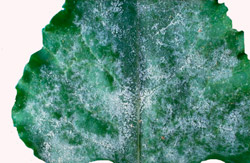 Powdery mildew is a fungal disease that attacks the foliage, stems and sometimes the flowers and fruit of a wide range of plants. The symptoms are a superficial whitish-grey fungal growth that covers the surface of the affected part of the plant.
Powdery mildew attacks a wide range of plants. These include ornamental plants: acanthus, clematis, delphinium, lonicera (honeysuckle), phlox, rosa (roses), rhododendron, quercus (oak); and edible plants: apple, blackcurrant, courgette, cucumber, gooseberry, grape, marrow, pea.
There are numerous different powdery mildews, and each one attacksone or just a few related plants; for instance, the powdery mildew affecting roses is a different species from the one that attacks clematis.
Symptoms
White, whitish-grey, powdery spreading patches of fungus on upper or sometimes lower leaf surfaces, stems, flowers &/or fruit.
Affected parts sometimes become stunted or distorted.
Control
To prevent the disease spreading, affected parts of the plant should be carefully removed and destroyed. This is particularly important in the autumn as destroying fallen infected leaves will reduce the amount of spores the following spring.
The problem is always worse on plants that are under water stress, especially when growing in dry soil. Mulching around the plants and regular, correct watering at times of warm, dry weather reduces water stress and helps make plants less prone to infection.
As the disease spores need moisture to germinate and grow, only water the soil not the plants - keep the soil moist but the leaves dry.
As most powdery mildew fungi have a restricted host range, but these can include wild relatives that can be a source of infection, remove closely related plants - especially weed species.
Some varieties of some plants have powdery mildew resistance, so check plant catalogues for details.
Chemical control
There are a number of chemical controls for powdery mildew. These can only be used on ornamental plants. These include FungusClear Ultra and Provanto Fungus Fighter.
Garden fungicides always work better as a prevention/protection rather than a cure, so always spray a fungicide before the disease gets hold.
I've also tried Plant Invigorator SB with good results. This is not a pesticide per se, as it protects/controls by physical methods.
Although it is illegal for me to recommend it, research has shown that a 10% mixture of full-fat milk applied twice a week is an effective control. Which? Gardening magazine had a report on this in its October 2010 issue.
Use plant protection products safely. Always read the label and product information before use.
If you want to know more, or if you've got a gardening problem you need help with, then send an e-mail to: info@gardenforumhorticulture.co.uk
Problems with slugs & snails, aphids, scale insect, vine weevil or lily beetle?